Monday, September 16, 2013

Oil Painting 101-The Foundations, fall 2013


Oil Painting 101, The Foundations has just begun. This class will cover materials and procedures, drawing and design, the practice and philosophy of oil painting. During the class, there will be presentations and demonstrations, actual painting time with personal instruction and critique, designed to bring the student from their present level to the next level.  In short, it’s the class that I tried to find when I was starting out in oils but could not find. We have a great group again this time and I am really looking forward to the fall semester. 
For our first day, I brought all the supplies that members will need to paint with oils, plus lots and lots of optional things (canvas choices, many palettes, every kind of brush, even easels!) that they might want, to make their life easier as they paint in and out of the studio.  Here they are, all packed into 10 easy-to-fit-into-the-Mini Cooper pieces!


I like this show-and-tell day because it allows everyone to see and touch and ask about things that they may have only heard about or seen in pictures. There aren’t many artists who don’t have a collection of things they thought they needed but didn’t. How much better to use someone else’s experience and save some time and money!
So, as we begin, our palette will be the most limited in history: one color + white. Starting like this will allow us to understand value as the most important foundational element in painting. Do you know that the human eye has 120 million rods, which interpret value, and only 6 million cones, which interpret color? Well it’s true and that is one of the reasons that it’s critical to be able to express a visual idea with value.

Our color is Transparent Oxide Brown, which is a very deep transparent partner for the opaque white. We will study why these characteristics are even important. In addition to value and temperature, we will explore line and edges using this pair and, when the time is right, we’ll add the three primaries: red, yellow and blue. By the end of the semester, we will have at least an understanding of the infinite capabilities of these few colors. Each class could easily be expanded into years of training, as it has been in the ateliers throughout art history. But we only have 4 months so I promise: we will only just scratch the surface!

Wednesday, August 28, 2013

Real Life

I am just emerging from the studio and seeing that it is going on 2 in the morning.

One of the things that I'm trying to do in my life right now is go to bed at "a reasonable hour." This goal has eluded me for my entire life but I will not give up because I keep reading about how good it is for you to have regular sleep habits and to let the sun wake you up. As a painter, I should be highly motivated to be up with the sun, but as a modern woman with really great studio lighting and really bad habits, I burn the midnight oil; I simply lose track of time. My theory/excuse is that, when you are doing the thing that God designed you to do, you have one foot on earth, one foot in heaven. Well, in heaven, as everyone knows, there are no clocks. Time is irrelevant. One is never late in heaven.
So I have a very lofty excuse for not being in bed at this time.
Now, to blog.

Someone recently said in my hearing that still lifes were boring. I asked him why he thought so and he replied that they always look staged, fake. Well, as a genre I suppose still lifes are long on still, short on life, but one of the fabulous things about still life painting is: YOU CAN CHANGE THAT. You are the master of everything when you paint still lifes. Clayton Beck once told me that if you don't like what you see in a still life, change your set up, change your position, or change your lighting. That is not possible for the landscape painter and it has only limited application for the portrait painter. (I might also add, when comparing still lifes as a subject to a model as a subject, that still lifes are free, you don't have to give them breaks every 20 minutes, and they stay up all night if you need them to. But I digress...)

These conversations were floating around in my head and my thinking was, just observe real things. Boring still lifes are just overly-orchestrated. Do what the landscape painters do and capture something from REAL LIFE and make a work of art out of it. Then BAM! I had the opportunity to practice what my mind was beginning to preach. My husband and I came home the other evening and when we turned on the kitchen light, he said, "Wow, that's a painting!" Looking at the produce on the counter I said, "Yeah, that would be a good painting!" Then he said, "Paint it! Now! I'll help you set up your gear."
Ha! Bluff called! My mind was saying, "But I'm tired! I'll take a picture of it and paint it later. It needs better lighting than the stove hood light anyway..." Immediately I was thwarting myself, but before anyone knew what was going on in my head, I said, "Okay, I will!"
So here you have my set up, my gear, my block-in:


And here you have a zoom of the produce because I'm not sure I like the composition, after all the work of painting it "as is." But the experience was very liberating; it was fun to explore something so close, so spontaneously. Perhaps I have a painting from it... we'll see: 


Wednesday, August 14, 2013

Lone Star Color Guard


One of my favorite painter peeps and I went to a Civil War reenactment by the 3rd Texas Cavalry Regiment last fall. What an exciting and wonderful experience! All the reenactors were required to be true to the time period. Even the children had their Ozarka water in authentic period bottles. Nary a cell phone nor digital camera was to be seen and I was beside myself with glee!
I have been working on paintings from the experience ever since then and many of them will be in the show coming up. I will shuffle them into the blog line-up but will save some until the opening, too.

This is a painting of the Texas Color Guard. I don't know why he was alone but the image was poignant: The Lone Guard of the Lone Star. One of my friends said the painting makes him feel sad but it makes me feel very proud. 

Tuesday, August 13, 2013

Life Painting of a Tree


It’s hot. Even when it’s only 95-100 degrees, the heat index has been up to the 120’s here during the day and it’s a challenge to paint out. I’ve discovered though, that if I go against the natural orientation of every atom in my body and set my alarm for 5 a.m. I can get out there and paint a couple of quick ones before it’s too unbearable. Also, if anyone else is going, we can have lunch afterwards, wax philosophical about our profession over some sweet tea, and leave much the richer for it!
Such was the case recently, two weeks in a row! This painting was the only one I caught on the second outing because, shocking, we were stopped by rain! Our drought has been so severe for so very long that I really don’t expect it anymore, regardless of the forecast. But, happily, rain it did.

Before the rain, there was a high, light overcast as the sun came up and most of this painting was laid in during that gray time. About a half an hour before the sky let loose, the sun peeked out a couple of times and I knocked in the spots that it caused and brightened the grass. When we were forced to throw in the towel, we huddled under a hatchback talking about our morning before dashing off to lunch. It was fun to be soaked and cold in July in south Texas.
Driving back to my studio afterwards I was thinking about how very much I love what I do. How many people can say that? I love every part of it, and just being allowed to do it makes me profoundly grateful.
One question we ask ourselves as painters is, “Is painting about painting, or is it about the painting?” Is it the experience of producing, or is it all about the product? My answer is, “Yes!” If you’re painting your experience, your product transcends the materials and conveys a time and a place, an experience, to someone else through the filter of a human being. It’s the beauty of 3 again: time, space, artist. I was the only one in that exact spot at that exact time and I had a skill that allowed me to create a unique record of it. Richard Schmid once said that fine art is the only form of communication that goes directly from mind to mind, no translation. I need to think about that some more but for now, here’s a painting of my experience and joy one recent morning, from me to you, with love. 
 http://kimcarlton.blogspot.com/

Monday, August 12, 2013

Risky Business


Two big challenges face us when we work. Tackling them requires a pre-existing plan, wisdom and courage.
Many, many things are happening when you paint. As you endeavor to convert 3 dimensions into 2 so that it looks like 3, your mind has to be both in the present and the future. You must be totally in the moment as you process the information and translate light into pigment, but you can’t lose sight of the final painting. The final painting will stand alone. If it doesn’t work, you have to deep six it, even if you’ve spent a LOT of time and effort on it.

So the pre-existing plan: to go for the most excellent product possible. Wisdom is required to remain objective in your judgment, and courage, to do something rash if the work does not meet your pre-existing plan. If you aim for nothing, as they say, you will be sure to hit it.

The two challenges then are, do not let any work become too precious to you, and do not over-work a piece. These are both lethal to good painting. If you grow fond of a passage that is holding the rest of the painting back, you will be reluctant to sacrifice it for the good of the painting. If the painting is not working, over-working is not necessarily the best solution. Sometimes you have to just scrape a painting. If there's a question, answer it honestly. I tell my own self, "When in doubt, scrape it out." 

Dan Gerhartz tells a story about painting with a friend for an afternoon. When it was time to wrap it up, he could hear, scriiiitch, scraaaatch, scriiiitch… He realized that his friend was scraping his painting off, and asked, “Hey, what are you doing?” His friend replied, “Well, my palette knife isn’t sharp enough to slash my wrists so…” It makes me laugh because I know exactly what that’s like.
Last Friday, our group had a lovely girl in a Greek costume posing for us. At the end of a very engaging 3 hours, I had a painting that maybe I should have left alone; it was only an exercise after all. But since I had a reference photo, I decided to use it and fix her crossed eyes. Once I started, I saw that really, she was all wrong, and Richard Schmid’s voice was whispering in my mind, “Never knowingly leave anything wrong on your canvas.” So I wiped from her eyebrows down and started over. The photos show the original work in progress, then the re-entry as I began the make-over (you can see how terrifying this step is, haha!), and finally the painting as it was when my time ran out. My favorite way to work when I'm doing portraits is to start from life, spend some time with reference work, then finish from life... but since this is only an exercise, I'm stopping now.  http://kimcarlton.blogspot.com/
 

.  

Wednesday, July 31, 2013

Follies and Foibles

I have a painting that I'm getting ready to sell and several paintings that are being prepared for a big solo show that I have coming up toward the end of the year, so I've been varnishing. I learned from Daniel Greene that the best and safest place to do that is in the bathroom. It can be closed off, there's a vent and probably a window, it can be made lint-free by removing the towels, rugs and curtains, and if you lay the paintings across the tub, there is total ventilation all around the painting as it dries.
I have been varnishing like this for many years without incident but today, disaster struck:

There were 3 paintings in there drying and when I went in to check on them, I was shocked and chagrined to see debris covering the paintings! Somehow (still a mystery), a large quantity of I-don't-know-what, including dead wasps, was spontaneously dumped from the vent on to the paintings. I am very thankful that the varnish was all but dry and I'm almost certain that I will be able to remove it from the paintings. Follies and foibles!
 
I will post a blog on varnishing in the not-too-distant future, and one on tubing your own paint. These are skills that are not really covered anywhere that I can find, so I have had to learn them in The School of Hard Knocks. I now feel totally free to share these kinds of things with you, not being locked in to the smaller mission of my past blog. The "old" blog tried to be very brief and to stick to one thing, directly related to a painting or a show, with very little comment. I know I scared some of you with my "Rededication" post, because I got lots of emails! I left the impression that perhaps I was going to retire from painting and take up preaching, which I am neither qualified nor inclined to do! I just wanted to break out of the tight little blog template and be free to share all kinds of things with you.

Finally, an administrative note. I believe I've received all of your emails but I know for sure I've not seen comments. We've readjusted some settings in hopes of making commenting easier, so if you want others to hear you here, leave a comment below. And subscribers, instead of being delivered to your inbox at 5 p.m., PYJ will now arrive in the morning, between 7 and 9.

Now, I'm off to the attic to see if I can find out how the vent "vented" on my paintings!

Tuesday, July 30, 2013

The Beauty of Three


Today, my husband and I were studying Dark Matter and Dark Energy, which together make up 95% of our universe ( 25% and 70% respectively), and about which very little is known.  Everything we actually know about is called Ordinary Matter (atoms, people, galaxies), which makes up only 5% of what is known to exist. These 3 things make up our universe.  

          Equally interesting is that there are only a few things comprising all that we are able to see (ordinary matter). Particle physics tells us that the atom, thought to be the smallest particle, actually has three parts to it: protons, neutrons and electrons. Further division reveals that protons and neutrons each have within them teeny tiny things called quarks, which appear in divisions of 3. There are 3 quarks in a proton and 3 quarks in a neutron. The string theories are even more interesting…

          When we were looking at matter that emits or absorbs light, of course I thought about painting. Light emits, pigments absorb. This is the science of painting! In the spectrum, there are 3 primaries and 3 secondaries, made up of 3 “warm” colors (red, orange and yellow) and 3 “cool” colors (green, blue and violet). And when I am painting, I follow John Singer Sargent’s value-compression strategy of pushing my values down to 3: light, mid-tone and dark. Even composition theory suggests divisions of 3 for finding the sweet spot and keeping things from being too static. I’m always thinking “3” when I work without really being conscious of it.

          We ourselves are said to be made up of body, soul and spirit; the soul being further divided into mind, will and emotions. When I’m working on the figure, I’m thinking, “eyes, nose, mouth… head, torso, legs… upper arm, lower arm, hand…” The way we’re made reminds me that we were made, and according to the Bible, we were made in God’s image. Artists deal in images. Images are products of the imagination that reflect the maker in some way. This finally reminds me of the Trinity: Father, Son, Holy Spirit; God in three persons. The Father reminds me of the soul. You can’t see the soul but it’s what “makes” a person that person: his mind, his will and his emotions. The Son reminds me of the body: the physical manifestation of the person and the Holy Spirit is the most mysterious of all. Not to make any grand theological statement; just to say that, thinking about life (birth, life, death) (past, present, future), I’m struck by the beauty of three.   

          This is part of a painting that I cropped to show an experiment that I did awhile back in spectral sequencing (laying out colored objects according to their order in the spectrum). The colors were red, blue and yellow (the primaries), with purple, orange and green (the secondaries) between:

Monday, July 29, 2013

The Nigerian Gele

20x16
I met Chelsea at the Salon International a couple of years ago and have been so very fortunate to have had her as a regular model all this time. She modeled for our Friday painting group, The Market Street Painters, a week ago, wearing an outfit that she wore to a Nigerian wedding this spring.
The elaborate headwrap is called a gele. My first-ever model was actually from Nigeria and taught me all the different ways to wrap one, and what each one meant. One way said, "I'm nubile," another said, "I'm a married," and some said things that, well, that embarrassed the model. I'm not sure but I think that these days the gele is more of a fashion statement; the more elaborate the better. I saw one once that was 3 feet tall with enormous yellow butterflies.
My original plan was to have much of the gele showing but Chelsea's eyes are just so wonderful that her face grew on my canvas until I could work with them. 20x16 is 20x16 so something had to give. It was the gele that gave.
Here's a promise though: I will soon paint another painting of Chelsea in this costume on a larger canvas and include the gele. When you see how voluminous and sculpturally interesting this thing is, your socks will roll up and down.

Saturday, July 27, 2013

THE NEW BLOG, PAINT YOUR JOY! A Rededication of the old blog, Paint Your Joy!


This is the first post of the new Paint Your Joy!
I just finished a book by Dr RC Sproul: The Holiness of God. The last chapter was called, Holy Space and Holy Time, and opened with this quote by CS Lewis: “Where, except in the present, can the Eternal be met?” I want to share an excerpt from it, as it was part of the reason for my rededication of this blog:

(Regarding the holy space where Moses saw the burning bush)…The sacred character of this spot was not intrinsic but extrinsic… made sacred by a super-added presence.  The event that occurred there loaned an extraordinary dimension to the ordinary… not only a theophany but also a hierophany… [Historian, Mircea] Eliade comments, “Every sacred space implies a hierophany, an irruption of the sacred that results in detaching a territory from the surrounding cosmic milieu and making it qualitatively different.”

(Regarding the holy space where Jacob dreamed of the ladder to heaven, awoke and was afraid and cried out: “How dreadful is this place: this is none other but… the gate of heaven.” He then took the stone he’d used as a pillow, set it on end, and he anointed it with oil. He named the place Bethel…) Eliade notes:…”The symbolism implicit in the expression “gate of heaven” is rich and complex; the theophany that occurs in a place consecrates it by the very fact that it makes it open above—that is, in communication with heaven, the paradoxical point of passage from one mode of being to another.”

Dr Sproul continues, Several significant images are connected in the interplay of this event. The first is the image of the ladder with the ascending and descending angels… the ladder serves as a connecting link between heaven and earth, the sacred and the profane. The second, this holy space receives a new name, Beth-el, precisely because it is deemed not only the “house of God” but also… a door that provides access to heaven. The third… is the image of the stone. Originally the stone was a common piece of rock used for a common purpose in antiquity, namely to serve as a pillow… After the hierophany, the stone is assigned a different purpose. It is transformed from its common purpose to an uncommon purpose.

So I was thinking about the purpose of this blog. Since its inception, its purpose has been common and small. I’ve even tried to limit my plain vanilla text to the space of one image! As a Christian though, my work should not be common or small but should somehow be material evidence of a creature who is madly in love with the Creator. Jesus, in John 1:51, said, “Truly, truly, I say to you, you will see heaven opened, and the angels of God ascending and descending on the Son of Man.” His visit to the planet was both a theophany and a hierophany, and the people who follow Him, who do see heaven opened, are supposed to point to Him in every aspect of their lives. Well, there are many more aspects to my life and art, and much more thought behind what I’m doing with them than what has shown here. I read the Bible every day. I write every day. I paint almost every day. I read a lot and think a lot, not just about painting but about physics and history and psychology; they all influence my art! And all the things I do and think are “open above.” I'm not going to preach but I do want to share.

So I now take this common stone that you’ve been using as a pillow to fall asleep, and I rededicate it, turning it on its side,so that it now points upward toward heaven.  

Monday, April 29, 2013

April Showers

 The first day of the Clarksville residency, Denise and I were forced to stay indoors because of the freezing cold rain. And by "forced to," I mean "got to." It was a wonderful day of music and laughter, hard work and joy. 
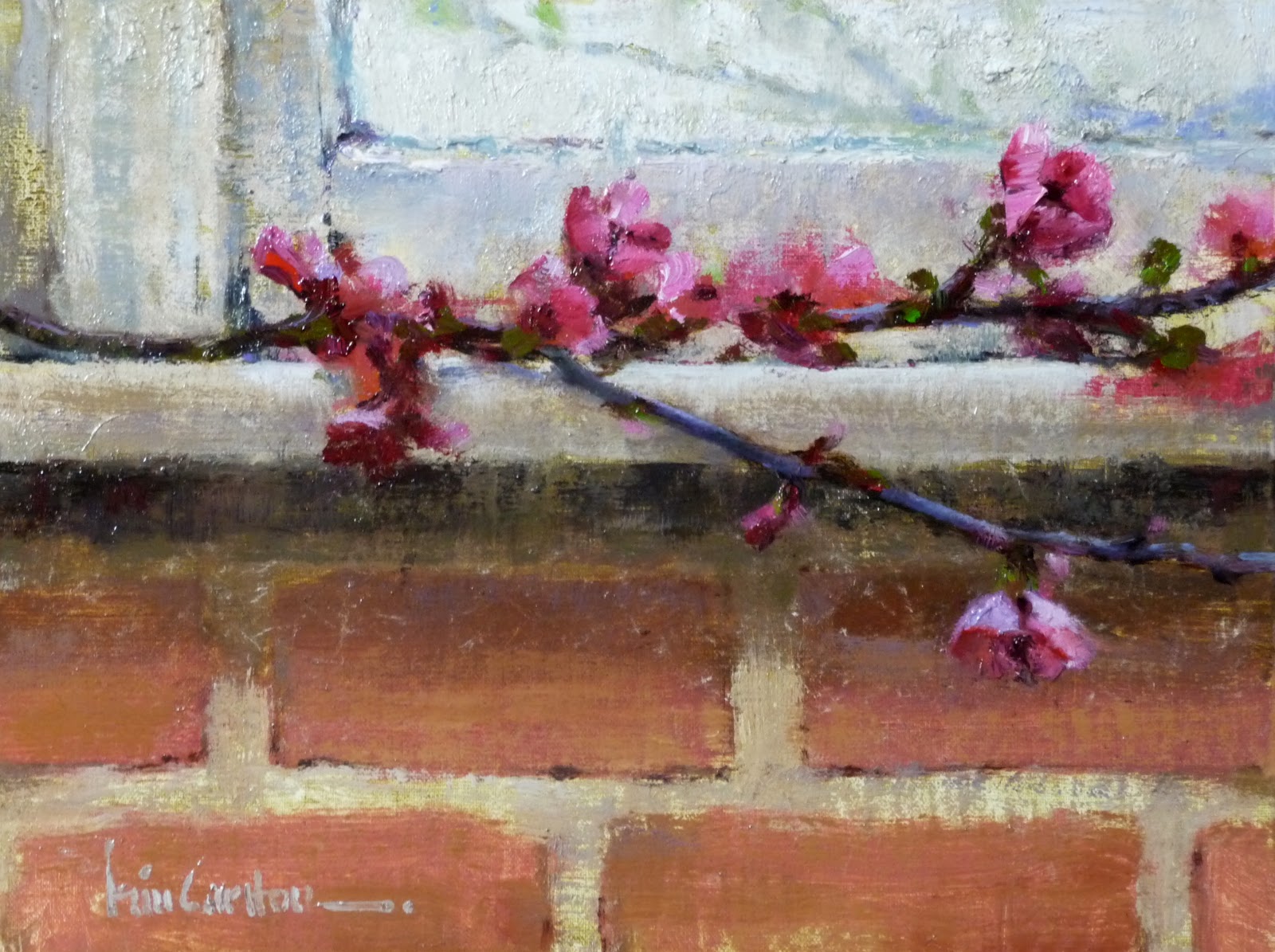
There are only two windows in the studio; she painted a scene out of hers (left) and I painted some flowers on mine (right) that I cut from the garden and taped to the sill.
The flowering quince, or japonica, was in full bloom, so I thought that a painting of them would mark the exact time on the calendar that we were there. I liked that they harmonized with the bricks and that they seemed to be trying to peek out the window at the other buds, just like Denise was doing.

This is my donation painting for the Red River Historical Society. It is 9x12 inches and called Japonica on the Windowsill
They are going to restore the old jail in town and convert it into a museum, the last we heard, and eventually have all the residents' contributions on display there. For the immediate term though, they will hang in the Lennox house, along with Martha Lennox's own paintings. I am honored to have my work hang alongside the work of such a woman as Martha.

Monday, April 15, 2013

The Color Wheel

The Color Wheel. Different from the charts in that it is not a value study at all, but a look at the spectral sequence that results from the three primary colors. At left, some of the OP-101 members are seeing how math and color collide as they measure out secondary and tertiary colors from the primaries. Isaac Newton was the first one to note the spectrum within a beam of light, and that the end of the sequence resembled the beginning; and voila! the color wheel was born. In addition to laying out neighboring colors, the artists are adding the complements in the inner ring, to see how quickly a color can be desaturated, and to learn the vast color potential of just three colors.
I'm off now, to paint the Spring! Thanks for stopping by.    

Tuesday, April 9, 2013

4 Color Charts

We are more than half-way into our adventure in the Oil Painting Foundations at the Woodlands Art League. We've gone from a concentration on the study of values, with only one color + white, into a full but limited primary palette. We are using brown, blue, red and yellow +white.
At left is our last assignment: Color Charts.
Each set of color squares represents one of our colors and how it relates to every other color (rows) and how those mixtures look in a 5-point value scale (columns).
I brought this chart with me on my residency trip and could see why Richard Schmid is so enthusiastic about having these done and with you in the field. It's useful in note-taking in your sketchbook and my resident partner used it on the first full-moon night for her sketches, noting that she would have remembered a much higher key had she not had the actual color-values in her hand to refer to. And as just an exercise, every single square requires skill, discipline and much consideration. The OP-101 members made me so happy with their excitement and efforts. I have a completely different plan for our color safari tomorrow.

Wednesday, April 3, 2013

The Residence

The Lennox House is "the residence" of the Artists in Residence program, sponsored by the Red River Historical Society in Clarksville, TX. It is still filled with the furnishings and effects of the family, and you feel very much the visitor while there. There is an artist's bedroom and studio, but even in those rooms there is the feeling of being in someone else's place. The last Lennox to live here was Martha Washington Lennox, an artist herself, who studied at the Art Students League in New York City and the Corcoran School of Art in Washington DC. That was pretty cool for a woman in the 30's. Many of her paintings hang in the home and I have grown very fond of her. I started painting her house the last time I was there and have been working very hard on it between then and now.

Tuesday, April 2, 2013

Chimney of the Charles DeMorse Home

 Colonel Charles DeMorse is known as the Father of Texas Journalism, having established and run The Northern Standard (later called The Standard) from 1842 until his death in 1887. His home is the oldest building in Clarksville, built in 1833, three years before Texas independence. It was a 2-room log cabin and the logs can still be seen in cut-outs on either side.
The thing that is most beautiful and intriguing to me is the odd chimney. It is unique and fairly beaten up. It appears to be made of pieces of ceramic tile, eight around, stacked four high with a metal cap on top. Like Texas, it stands proud atop its rough and tumble history: a survivor. The Historical Society is planning to restore this home, which bears national and state historic markers and is well worth preserving.

Monday, April 1, 2013

North Texas Residency

We had a wonderful eight days in North Texas but it was very, very cold. Still, we managed to get in about one painting a day; I'll post pics of the week as well as paintings from the residency in the coming days.
For today, I have a short video filmed by Steve Whalen who, with his wife Deborah Paris, conceived the Artist in Residence program. The video was taken on the day that this painting was done. I will leave both the video link and the residency link at the end of this post for you.
The sun was high when we set up, but as the barn faced west, the key shadows stayed relatively constant. I've learned that when you're cold, you paint smarter because you want to hurry up and get warm. We were promised a bonfire that evening and the thought of it gave us anticipatory warmth, but then, about midway through the afternoon, Steve came out with a box of piping hot tea! The box had lidded china tea cups, choices of tea, mason jars full of cream and sugar, and a thermos of hot water. Not at all uncivilized! 
Here are your links and I hope you enjoy them:
http://animoto.com/play/mk91tWZ8dbT70J4bhcYWlw#.UVOHBn46sco.blogger
http://artistinresidenceredrivercounty.blogspot.com/p/about-clarksville-red-river-county.html